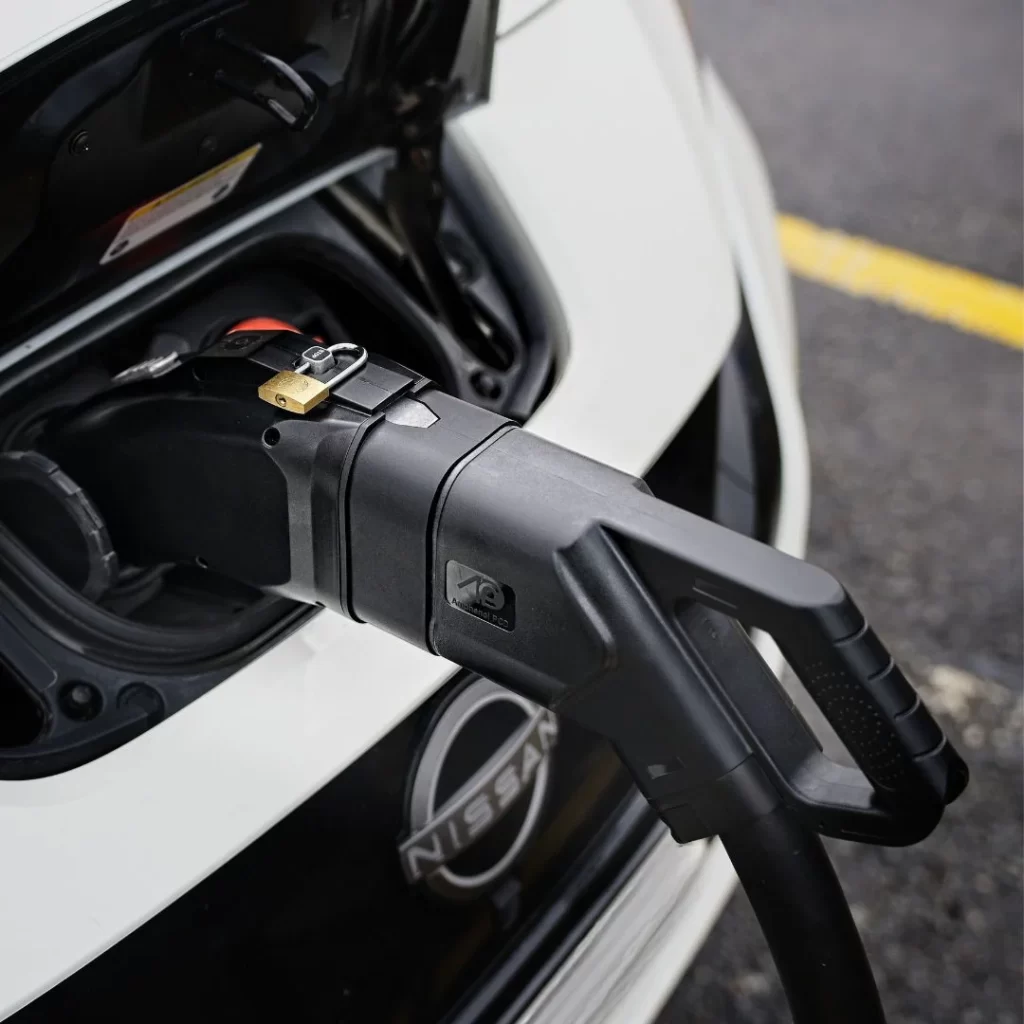
Buying a CCS to CHAdeMO adapter is not like buying a normal charging cable.
A normal cable mainly needs to fit your car and charging point. A CCS to CHAdeMO adapter has to do much more. It must handle high-voltage DC fast charging, communicate between a CCS charger and a CHAdeMO vehicle, work with different charging networks, and remain supported as charger software changes over time.
The goal of this guide is simple: help you understand what to check before buying any CCS to CHAdeMO adapter.
The best adapter is not necessarily the cheapest one. It is the one that works with your car, your region, your charging needs and your expectations after purchase.
Make sure you are buying the correct regional version
Start with the connector type.
For Europe, you normally need a CCS2 to CHAdeMO adapter. CCS2 is the standard CCS connector used at European fast chargers. In North America, the relevant connector is usually CCS1.
A CCS1 adapter and a CCS2 adapter are not interchangeable in normal use.
If a product listing is unclear about CCS1 vs CCS2, slow down before ordering. Buying the wrong regional version can make the adapter useless for your local fast chargers.
For European drivers, the search term you are usually looking for is CCS2 to CHAdeMO adapter or CCS to CHAdeMO adapter Europe.
Check whether your car is actually compatible
A CCS to CHAdeMO adapter is designed for cars that use CHAdeMO for DC fast charging. But that does not mean every CHAdeMO car automatically works with every adapter.
Compatibility should always be checked before ordering.
The most common use case is the Nissan Leaf, simply because it is by far the most widely sold CHAdeMO electric vehicle. As a result, compatibility is often best established and most thoroughly tested with Leaf models. Most CCS to CHAdeMO adapters also work with other CHAdeMO vehicles, but compatibility can vary depending on the specific car and adapter. It is always a good idea to confirm compatibility with the seller before ordering.
A broad claim such as “works with CHAdeMO cars” is not enough. A good seller should help you verify whether the adapter is suitable for your specific vehicle.
Look for real-world charger compatibility
Car compatibility is only half of the story.
A CCS to CHAdeMO adapter also has to work with the CCS chargers you actually use. Public fast chargers are not identical. Different charger manufacturers, charging networks and software versions can behave differently during the charging handshake.
Look for evidence that the adapter has been tested with real charging networks and real charger brands.
Useful information includes:
- tested charger brands
- tested charging networks
- customer reviews from your country
No adapter should be presented as perfect with every charger in every situation. A station can be offline, occupied, restricted, recently updated or temporarily incompatible.
A good adapter is not one that promises impossible universal compatibility. A good adapter has real-world testing, firmware support and a way to deal with problems if they appear.
Understand what the adapter can and cannot do
A CCS to CHAdeMO adapter gives a CHAdeMO car access to CCS fast chargers. It does not change the car’s battery management system.
Your car still controls:
- maximum charging power
- battery temperature limits
- charging curve
- state-of-charge limits
- when charging slows down
- when charging stops
An adapter cannot make an older car accept more power than the car is designed to receive.
For many drivers, the value is not mainly about getting higher peak charging speeds. The value is access. More CCS charging locations can mean fewer detours, more backup options and less dependence on old CHAdeMO chargers.
If you buy a CCS to CHAdeMO adapter expecting it to turn your car into a modern ultra-fast-charging EV, you may be disappointed. If you buy it to make a CHAdeMO car more usable in a CCS-focused charging network, the value is much clearer.
Check firmware support before buying
Firmware support is one of the most important long-term features of a CCS to CHAdeMO adapter.
The adapter has to manage communication between a CCS fast charger and a CHAdeMO car. Charging station software can change. New charger models appear. Charging networks update their systems. A firmware update path helps the adapter keep up with those changes.
Before buying, ask:
- Who provides the firmware?
- How are updates delivered?
- What happens if a charger stops working after a network software update?
- Does the seller help with firmware-related troubleshooting?
An adapter may work today, but the more important question is how it will be supported if charger behaviour changes later.
Consider open-source firmware support
The Longood CCS to CHAdeMO adapter has a rare advantage in this category: it is the only CCS to CHAdeMO adapter supported by an independent open-source firmware project.
For normal buyers, it means the adapter has a wider development ecosystem behind it.
Open-source firmware can support:
- compatibility improvements
- bug fixes
- charger-specific improvements
- useful additional features
- development that is not dependent only on the original manufacturer
The manufacturer also now ships new Longood adapters with this open-source firmware direction.
This makes firmware support a real buying criterion. When comparing adapters, ask whether the alternative has any comparable long-term software support. If the only answer is “the factory may release updates,” that is a different support situation.
Check what happens if charging does not start
A failed charging session does not automatically mean the adapter is broken.
Charging may fail because:
- the adapter is not fully seated in the CHAdeMO inlet
- the CCS plug is not fully locked into the adapter
- the adapter’s internal battery is low
- the charger timed out during the handshake
- the car is already at a high state of charge
- the charger has a temporary fault
- the station recently received a software update
- firmware support is needed
Good support can help separate these causes.
Before buying, check whether the seller provides practical troubleshooting help. A seller should understand the product well enough to guide you through connection order, LED behaviour, internal battery charging, firmware updates and station-specific issues.
Look at warranty, returns and total cost
Do not compare only the product price.
Compare the full buying situation:
- Is VAT included?
- Is delivery included?
- Are there import duties?
- Are there customs fees?
- Is the seller inside the EU?
- How long is the warranty?
- Is there a satisfaction guarantee?
- Who handles returns?
- Who pays return shipping?
- Is warranty service realistic if something goes wrong?
This is especially important for EU customers. A lower price from outside the EU may become less attractive if taxes, customs, shipping or warranty handling are unclear.
A CCS to CHAdeMO adapter is a high-value product. Clear terms reduce risk.
Check safety and build-quality information
A CCS to CHAdeMO adapter should not be presented like a harmless travel plug.
It is used with high-voltage DC fast charging. It is connected to heavy public charging cables. It may be used outdoors, in rain, snow, dust, freezing weather and motorway charging stops.
Before buying, ensure the product information includes details about:
- voltage rating
- current rating
- protection class
- operating temperature
- outdoor use
- safe connection order
- safe disconnection order
- warnings about damaged equipment
- whether the adapter can be opened or repaired by the user
- compliance information
- manufacturer information
Avoid vague safety claims. Good product information should be specific.
Check what comes in the package
The accessories matter more than buyers often expect.
A good package should support real use, not just the first unboxing.
Look for:
- user manual
- quick-start guide
- storage bag
- update cable
- USB flash drive or update accessories
- USB-C charging option
- charging instructions
- troubleshooting guidance
- support contact information
Firmware update accessories are especially useful. If the adapter needs an update later, you do not want to discover that the required tools were never included.
Read customer reviews carefully
A star rating is useful, but review details are more valuable.
For a CCS to CHAdeMO adapter, good reviews often mention:
- car model
- battery size
- country
- charger network
- charger brand
- long-distance travel
- whether support was needed
- whether the seller helped resolve any issues
- whether the adapter worked repeatedly
A review saying “works great” is nice. A review saying “worked with my Nissan Leaf on this charger network during a trip” is more useful.
Watch for red flags
Some warning signs should make you slow down before buying.
Be careful if a seller or listing has:
- unclear CCS1 or CCS2 version
- vague voltage or current ratings
- no compatibility information
- no real car model guidance
- no firmware update information
- no warranty terms
- unclear VAT or customs costs
- no clear seller identity
- only generic product photos
- no meaningful customer reviews
- claims that it works with every car and every charger
- no support after purchase
- no safe-use instructions
One weak point is not always a dealbreaker. Several weak points together are a problem.
A CCS to CHAdeMO adapter is often bought to solve charging uncertainty. The purchase itself should not create more uncertainty.
Use this buying checklist before ordering
Before buying a CCS to CHAdeMO adapter, go through these points one by one.
- Region: Make sure the adapter is the correct version for your market. In Europe, you normally need CCS2. In North America, you normally need CCS1.
- Car compatibility: Check that your exact vehicle model is supported. If possible, confirm the battery version and any known limitations before ordering.
- Charger compatibility: Look for real-world use with relevant CCS charger brands and charging networks, not only a general claim that the adapter works with CHAdeMO cars.
- Technical rating: Check that the product information clearly states voltage and current specifications. Vague claims are not enough for high-voltage DC fast-charging equipment.
- Firmware support: Find out how firmware updates are handled. A good adapter should have a clear update process and a realistic path for compatibility improvements.
- Long-term support: Consider what happens if charging networks change their software. Manufacturer support, seller support and open-source development can all make a difference over time.
- Seller: Buy from a real company with clear contact details, product knowledge and support after purchase.
- Warranty: Check the warranty period and how warranty claims are handled in practice.
- Returns: Look for a clear return policy or satisfaction guarantee, especially if you want to test the adapter with your own car and local chargers.
- Total cost: Compare the full cost, not only the product price. VAT, delivery, customs, import duties and return shipping can change the real price.
- Safety information: Look for clear instructions, warnings, IP rating, compliance information and safe connection and disconnection procedures.
- Accessories: Check what is included in the package. A manual, storage bag, update tools and charging instructions can make the adapter much easier to own.
- Reviews: Read customer feedback carefully. The most useful reviews mention the car model, charger network, country and whether the adapter worked repeatedly in real use.
If an adapter gives clear answers to these points, it deserves consideration. If several answers are missing, the lower price may simply mean more uncertainty after purchase.
When is a CCS to CHAdeMO adapter worth buying?
A CCS to CHAdeMO adapter is usually most worthwhile if you plan to keep driving a CHAdeMO car and want more fast-charging options.
It may be worth buying if:
- you drive a compatible Nissan Leaf, Nissan e-NV200, Lexus UX 300e or another CHAdeMO vehicle
- your local CHAdeMO chargers are disappearing, broken or often occupied
- you want to use modern CCS fast chargers
- you drive longer distances
- you want more backup charging options
- you want to keep your current EV for several more years
- replacing the car would cost much more than buying the adapter
- better charging access would improve the car’s practical value
For many drivers, the adapter is not an impulse purchase. It is a way to keep a familiar electric car useful as the charging network changes.
Why we sell the Longood CCS to CHAdeMO adapter
At Autonlaturit.com, we sell the Longood CCS to CHAdeMO adapter because, based on our experience, it is the most reliable and practical option currently available for compatible CHAdeMO vehicles. It was the first CCS to CHAdeMO adapter on the market, so it has a longer real-world testing history than newer alternatives.
As a trusted Finnish retailer, we provide fast customer support, free delivery, a 30-day satisfaction guarantee and a 2-year warranty. Because CCS to CHAdeMO adapters are technical products that may require compatibility checks, firmware updates or troubleshooting, we believe that knowledgeable support after purchase is just as important as the hardware itself.
No adapter should be bought on brand name alone, and no adapter can be guaranteed to work with every charger in every possible situation. But if you want a CCS to CHAdeMO adapter with a long track record, clear technical specifications, update support, practical instructions, warranty coverage and a seller that can help after purchase, Longood is the adapter we are confident to offer.
Bottom line
For many CHAdeMO owners, the main benefit of a CCS to CHAdeMO adapter is simple: access to more charging options. As CCS chargers become more common, an adapter can make everyday driving and longer trips easier by reducing dependence on the shrinking CHAdeMO network. For drivers who plan to keep their current EV for years to come, it can be a practical way to maintain flexibility and get more value from a car they already know and trust.
For a CHAdeMO driver, the real question is not only “does this adapter fit?” or “is this the cheapest adapter available?” The better question is: “will this adapter keep my car practical as the charging network continues to move toward CCS?”