You cannot make a Nissan Leaf accept unlimited charging power, but you can reduce the amount of time that charging adds to a journey.
The biggest savings often come from avoiding unnecessary charging, leaving a fast charger at the right time, choosing better charging locations and having backup options when a charger is occupied or unavailable.
Here are five practical ways to spend less time charging a Nissan Leaf.
1. Start longer trips with as much charge as practical
The easiest charging stop to save time on is the one you never need to make.
If you can charge at home before a longer journey, starting with a well-charged battery lets you cover more of the trip before you need public fast charging. Depending on the journey, it may eliminate one charging stop completely.
This is particularly useful with an older Nissan Leaf, where public fast charging may require more planning than with a newer CCS-equipped EV.
Home or overnight charging also has another advantage: you are not spending travel time waiting for the battery to charge. The car can charge while it is parked anyway.
For a trip that starts early in the morning, having the car ready before departure is usually more efficient than leaving with a partly charged battery and planning an early fast-charging stop.
You do not need to charge to 100% before every drive. The useful principle is simply to use convenient stationary time for charging whenever it reduces the amount of public charging you need later.
2. Don’t wait for 100% at every fast charger
Fast charging does not happen at the same speed throughout the entire session.
Nissan states that the Leaf’s quick-charging rate becomes slower as the battery state of charge increases. Battery temperature and charging conditions can also affect the rate.
If you already have enough energy to reach your next planned stop with a sensible reserve, waiting for the battery to get close to full may add more time than it saves.
Instead of asking:
“How full can I get the battery?”
A better question on a road trip is:
“How much charge do I need to comfortably reach the next useful stop?”
Sometimes that means leaving well before 100%.
There is no universal percentage that every Leaf owner should use. Different Leaf versions have different battery capacities, and weather, speed, battery condition and the distance to the next charger all affect how much energy you actually need.
Watch the remaining range, the charging rate and your next destination rather than treating a full battery as the goal of every fast-charging session.
If you need the extra range, continue charging. If you do not, getting back on the road may be faster.
3. Choose charging locations with backup options
A charging stop can waste time before charging even begins.
You may arrive to find that the only CHAdeMO connector is occupied. The charger may be offline. Another car may have just started a long session. The station may simply fail to start a charge.
A site with several usable charging options gives you a better chance of plugging in immediately.
Before a longer trip, look at more than the distance between chargers. Consider whether the site has several charging stalls, whether another suitable station is nearby and whether the location is directly on your route.
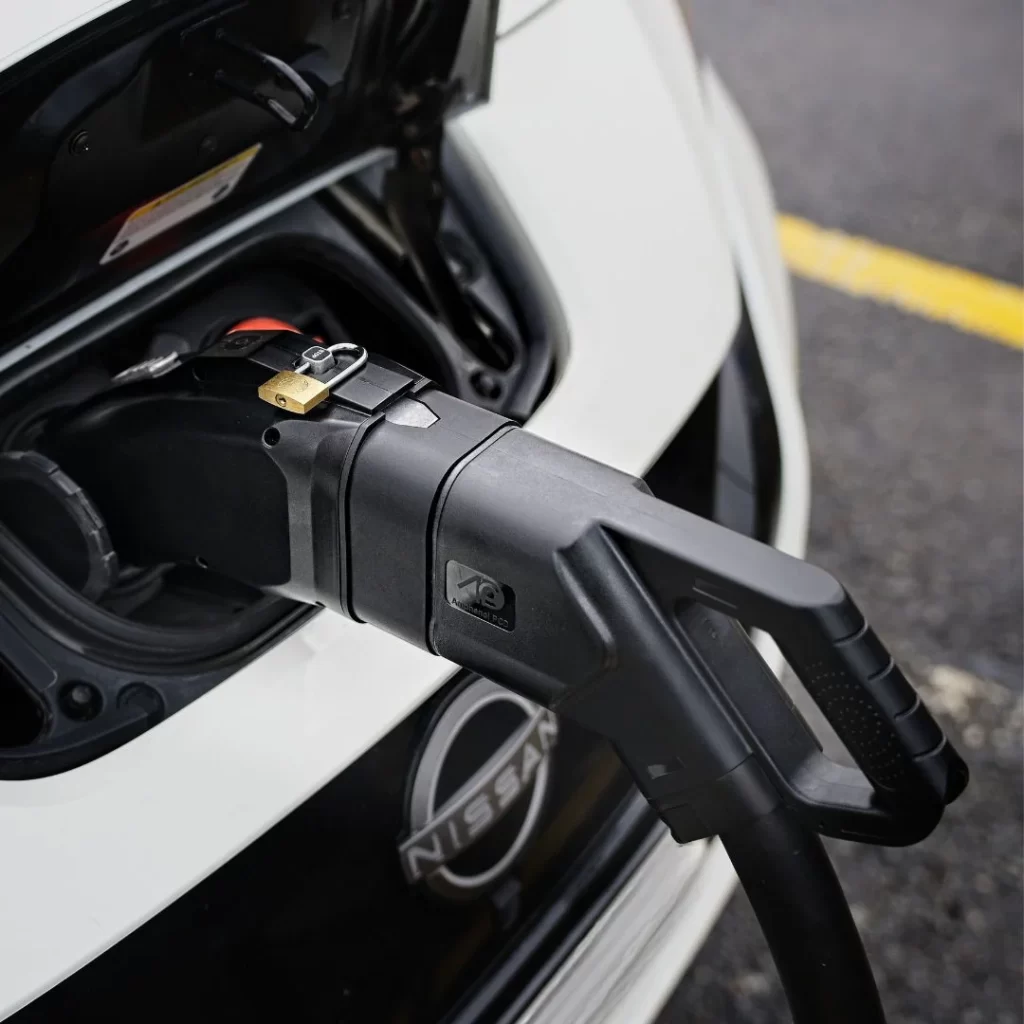
This is also where a CCS to CHAdeMO adapter can make a significant difference for older Nissan Leaf owners.
A CHAdeMO-equipped Leaf normally depends on CHAdeMO fast chargers. A compatible CCS2 to CHAdeMO adapter gives the car access to compatible CCS2 fast chargers as well.
That does not make the Leaf itself capable of accepting the full output of a 150 kW or 300 kW CCS charger. The vehicle still determines the charging power.
The time saving comes from having more places to charge.
If a charging hub has several CCS stalls but only one CHAdeMO connector, being able to use compatible CCS chargers can reduce waiting and make it easier to move to another stall if one charger is unavailable.
The Longood CCS2 to CHAdeMO adapter sold by Autonlaturit.com has been tested with several Nissan Leaf battery versions and is designed to give compatible CHAdeMO Leafs access to CCS2 fast charging.
For drivers who regularly travel beyond their home-charging range, having both CHAdeMO and compatible CCS charging available can make route planning considerably more flexible.
4. Take battery temperature into account on long journeys
The first fast charge of the day may not behave like the third.
Nissan states that Leaf quick charging can take longer when the battery temperature is high or low. It also notes that successive quick charges can take longer if battery temperature causes the car’s battery protection system to limit charging.
Battery temperature can rise during repeated fast charging, sustained higher-speed driving and hot weather.
This matters when planning a long journey.
Do not build a tight schedule around the assumption that every charging stop will take exactly the same amount of time.
If the battery has become hot after several hours of driving and previous fast charges, waiting longer at the next charger may not produce the charging performance you saw earlier in the day.
A slightly more efficient driving pace can sometimes save time overall as well. Lower energy consumption means less energy has to be replaced at the charger and may allow you to reach the next stop with more remaining charge.
There is no need to chase a specific battery temperature or invent a fixed rule for when to stop. Simply be aware that battery temperature is one of the factors the Leaf uses when determining charging performance.
5. Make the charging stop do two jobs at once
Charging time does not have to be completely lost time.
For longer journeys, choose charging locations where you can do something you would need to do anyway.
Use the charging stop for:
- a meal or coffee
- a toilet break
- stretching your legs
- buying food or drinks
- checking the next part of the route
If you were going to stop for 20 or 30 minutes anyway, charging during that break adds much less extra time to the journey.
Location matters more here than the biggest charging-power number shown in an app.
A conveniently located charger beside your route with food and toilets may save more actual travel time than a theoretically faster charger that requires a detour.
It also helps to check the charging station before you arrive.
Make sure you know which network operates it, how the session is started and what payment options are available. If a particular operator requires an app or account, setting that up before the trip is easier than doing it in a car park while everyone is waiting.
A few minutes of preparation can prevent a simple charging stop from becoming a frustrating one.
Is a higher-powered charger always faster for a Nissan Leaf?
No.
A charger’s maximum rating tells you what the charger is capable of delivering, not what the Leaf will necessarily accept.
Nissan specifies different quick-charging limits for different Leaf battery versions. The car also adjusts charging power according to battery state of charge, battery temperature and other charging conditions.
For that reason, driving farther out of your way simply to reach a charger with a larger kW number may not save any time.
A working charger that your car can use, located directly on your route, is often the better choice.
The same applies when using a CCS to CHAdeMO adapter. A high-power CCS station can be useful because of its location, reliability and number of available stalls even when the Leaf cannot use the station’s full rated power.
Can a CCS to CHAdeMO adapter reduce charging time?
It can reduce the total time you spend dealing with charging, even if it does not increase the Leaf’s maximum charging capability.
Consider two different situations.
At the first location, there is one CHAdeMO charger. It is occupied, so you have to wait or drive to another CHAdeMO station.
At the second location, your Leaf can also use compatible CCS chargers through an adapter. Several suitable stalls are available, so you can start charging immediately.
The battery may charge at a similar rate in both situations, but the second charging stop can still be much faster from the driver’s point of view.
The same applies to route planning. Having more compatible chargers can reduce detours and make it easier to choose a stop at the right point in the journey instead of driving specifically to one of the remaining CHAdeMO locations.
An adapter is therefore better viewed as a way to increase charging options than as a device that makes the battery itself charge faster.
Should you fast charge less often?
For daily driving, home or destination charging is usually the most convenient option when it is available.
Nissan also recommends normal charging where practical and minimizing repeated quick charging as part of its guidance for preserving battery life.
On road trips, however, fast charging is there to be used.
The aim does not need to be avoiding fast charging entirely. A better approach is to avoid unnecessary fast-charging time.
Start with enough energy when possible, stop where it makes sense, take the amount of charge you actually need and continue your journey.
What causes Nissan Leaf charging stops to take longer than expected?
Several factors can add time:
- arriving at an occupied charger
- finding that a charger is out of service
- driving a detour to reach the only suitable CHAdeMO station
- waiting for a high state of charge when the charging rate has already fallen
- repeated fast charging with a hot battery
- arriving at a charger without knowing how to start or pay for the session
Not all of these can be avoided every time.
But most can be reduced with better planning and more charging options.
Bottom line
To spend less time charging a Nissan Leaf:
- Start longer journeys with plenty of charge when possible.
- Leave a fast charger once you have enough energy for the next part of the trip instead of automatically waiting for 100%.
- Choose charging locations with backup options.
- Remember that battery temperature can affect repeated fast charging.
- Combine charging with stops you would make anyway.
For CHAdeMO-equipped Leafs, a compatible CCS to CHAdeMO adapter can also reduce time spent searching, waiting and making detours by opening access to compatible CCS2 charging stations.
The Leaf will still decide how quickly its battery can charge. Saving time is mostly about making better use of the charging time around it.