You arrive at a fast-charging site with your Nissan Leaf, the battery is getting low, and there are six shiny CCS2 chargers in front of you.
There is just one problem.
Your Leaf has CHAdeMO.
For a long time, that meant those CCS2 chargers were effectively useless. You had to find a CHAdeMO charger somewhere else, take a detour, or settle for slower AC charging.
That is no longer necessarily the case.
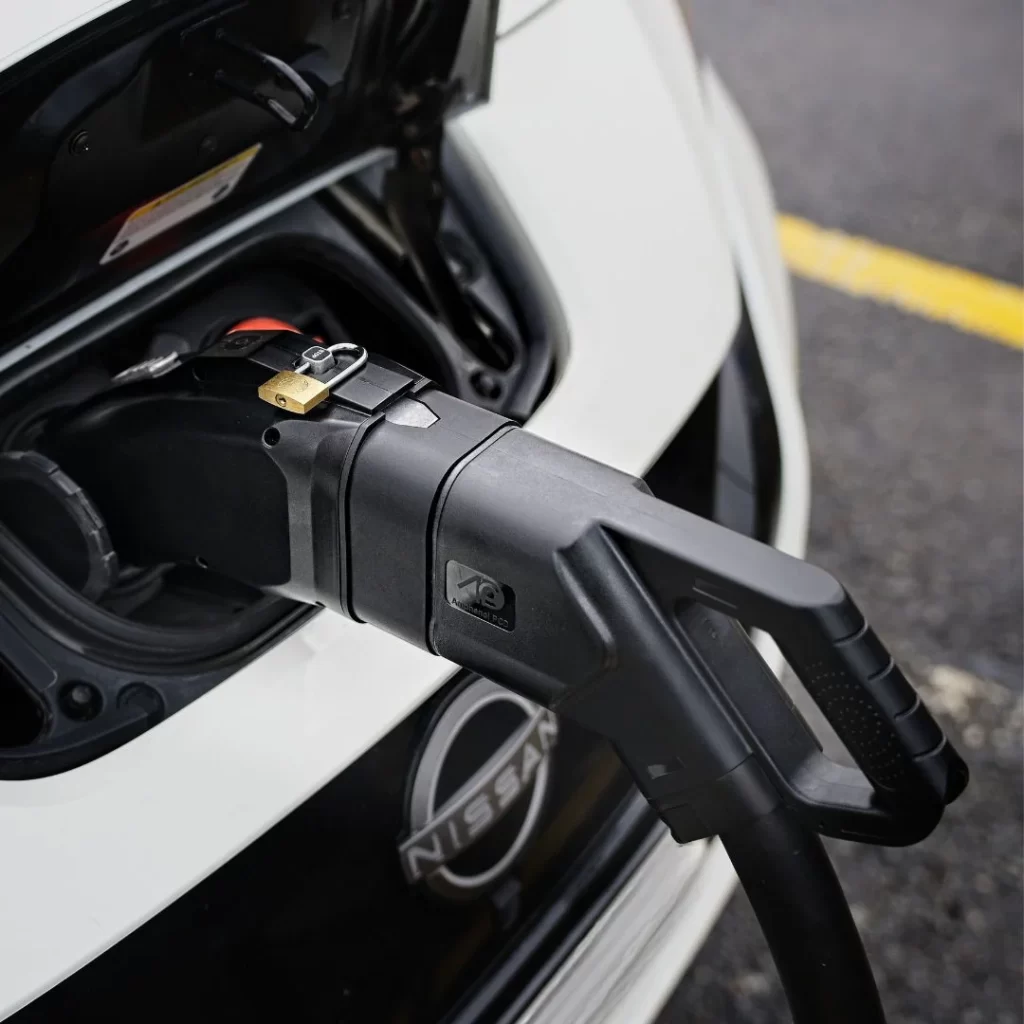
If your Nissan Leaf has a CHAdeMO fast-charging port, a compatible CCS2 to CHAdeMO adapter can allow you to fast-charge at many CCS2 stations in Europe.
For older Leaf owners, that can make a big difference. CCS2 has become the dominant fast-charging standard across Europe, while CHAdeMO chargers are becoming harder to find on many routes.
So what happens when there is no CHAdeMO charger nearby, but plenty of CCS2 chargers?
You may still be able to charge.
Can you fast-charge a Nissan Leaf at a CCS2 station?
Yes, if your Leaf has a CHAdeMO fast-charging port and you use a compatible CCS2 to CHAdeMO adapter.
You cannot simply plug a CCS2 cable into an older Nissan Leaf. The connectors are different, and the two charging standards also communicate differently with the car.
That is why a CCS2 to CHAdeMO adapter is not just a piece of plastic that changes the shape of the plug. It contains electronics that communicate with both the CCS2 charger and the Leaf.
The charger sees the CCS2 side of the adapter, while the Leaf communicates with the CHAdeMO side.
For the driver, the result is much simpler: CCS2 fast chargers that were previously unusable can become charging options.
Why is this becoming more useful for Leaf owners?
The Nissan Leaf was one of the world’s most important early electric cars, and CHAdeMO was once common at European fast-charging stations.
The charging network has since moved heavily towards CCS2.
New charging hubs may have four, eight or even more CCS2 chargers, while offering only one CHAdeMO connector or none at all. Older CHAdeMO chargers are also gradually being replaced as charging sites are upgraded.
That creates an unusual situation for Leaf owners.
The car can still work perfectly well, but the infrastructure around its original fast-charging standard is becoming less convenient.
A CCS2 to CHAdeMO adapter addresses that specific problem. It does not modernise the Leaf itself. It simply gives the car access to a much larger selection of charging stations.
Which Nissan Leaf models can use a CCS2 to CHAdeMO adapter?
This article applies to Nissan Leafs equipped with a CHAdeMO DC fast-charging port.
The easiest way to check is to open the charging flap. If your Leaf has the large round CHAdeMO inlet, it is the type of vehicle that may be able to use a CCS2 to CHAdeMO adapter.
The Longood CCS2 to CHAdeMO adapter sold by Autonlaturit.com has been tested with Nissan Leaf models using 24 kWh, 30 kWh, 40 kWh and 62 kWh batteries.
There is now one important exception.
The newest generation Nissan Leaf sold in Europe uses CCS fast charging from the factory. It does not need a CCS2 to CHAdeMO adapter.
So when people talk about using a CCS adapter with a Leaf, they are generally referring to the earlier CHAdeMO-equipped generations.
How does a CCS2 to CHAdeMO adapter work?
CCS2 and CHAdeMO are both designed for DC fast charging, but they use different connectors and communication protocols.
The adapter acts as the translator between them.
You connect the CHAdeMO side to the Leaf and the CCS2 charging cable to the other side of the adapter. The electronics inside then handle the communication required to start and maintain the charging session.
The Leaf still controls the battery.
The adapter does not bypass the car’s battery management system or force the battery to accept more power than it normally would. Charging limits, battery temperature protection and charging behaviour remain under the Leaf’s control.
This is an important difference between adapting the charging connection and modifying the vehicle. You are giving the Leaf another way to access DC electricity, not changing how the battery itself charges.
How do you charge a Nissan Leaf at a CCS2 station?
With the Longood adapter, the process is straightforward once you know the correct order.
First, connect the adapter securely to the Leaf’s CHAdeMO port. Then connect the CCS2 cable from the charging station to the adapter.
Start the charging session using the method required by the charging operator. Depending on the station, this could be an app, RFID card, payment terminal or the charger screen.
After starting the session, press and hold the adapter’s ON/OFF button for three seconds. The adapter begins establishing communication between the CCS2 charger and the Leaf.
When charging starts successfully, the indicator light changes from blinking to steadily lit.
Before walking away, check the charger or the Leaf to make sure the car is actually receiving power.
When you want to leave, stop the charging session first. Wait until charging has ended before disconnecting the CCS2 cable and adapter.
It is also worth charging the adapter’s internal battery before a journey. The Longood adapter uses its own battery to power its electronics.
Will it work at every CCS2 charger?
No adapter can realistically guarantee operation at every CCS2 charger in Europe.
Fast chargers come from different manufacturers and run different software versions. Charging networks also update their equipment over time.
This matters because a CCS2 to CHAdeMO adapter has to translate communication between two charging standards. If a charger behaves differently after a software update, adapter firmware may also need to be updated.
The Longood adapter has been tested with a wide range of European charging equipment, including hardware from manufacturers such as ABB, Kempower and Alpitronic. It has also been used at major European fast-charging networks.
The adapter can receive firmware updates through USB, which is particularly useful for a product whose compatibility depends partly on evolving charging infrastructure.
In practice, it is better to think of the adapter as greatly expanding your charging options rather than making every CCS2 charger universally compatible.
How fast can a Nissan Leaf charge through the adapter?
A 300 kW CCS2 charger will not make a Nissan Leaf charge at 300 kW.
The charger can offer power, but the car determines how much it actually accepts.
Older Nissan Leaf models typically charge at around 40 to 50 kW under suitable conditions. With the Longood adapter, 62 kWh Leaf models have reached approximately 70 to 75 kW on compatible CCS chargers.
Actual charging power can be lower.
Battery percentage, battery temperature and the charging station itself all affect the result. Charging power will also decrease as the battery fills.
The Leaf’s battery temperature remains particularly important during repeated fast charging. Older Leafs do not use the same active liquid battery cooling found in many newer electric cars. After motorway driving and several rapid charges, the car may reduce charging power to protect the battery.
The adapter cannot remove that limitation.
Its main advantage is therefore not necessarily faster charging. It is access to more chargers.
What if the CCS2 charging session does not start?
A failed charging attempt does not automatically mean there is something wrong with the Leaf or the adapter.
First check that both connectors are fully inserted. High-power CCS2 cables can be heavy, and a cable pulling on the adapter can sometimes prevent a proper connection.
Also check that the adapter’s internal battery is charged and that you followed the correct startup order.
If the charger gives an error, end the session and try again. At a charging hub with several stalls, trying another charger can also be worthwhile.
Individual chargers occasionally fail even when identical chargers beside them work normally.
If the same problem occurs repeatedly at different locations, firmware should also be checked. Charger software changes over time, which is why updateable firmware is a useful feature in an active CCS2 to CHAdeMO adapter.
For troubleshooting, the charger operator, charger model, error message and adapter indicator behaviour are all useful information.
Does the adapter make road trips easier in a Nissan Leaf?
This is where the adapter can have the biggest effect.
Imagine a route with three CHAdeMO chargers separated by long distances. Without an adapter, those three locations may determine your entire journey.
If one is broken or occupied, your options become limited very quickly.
Now imagine that the same route also has several large CCS2 charging hubs.
With a compatible adapter in the car, some of those locations become available to your Leaf as well. You are no longer planning around only one connector standard.
That can be more important than the charging speed itself.
A modern charging hub with several working CCS2 stalls is often a better backup than depending on one CHAdeMO connector at an older station. Even if your Leaf charges at roughly the same power, having several possible chargers reduces the risk of getting stuck waiting for one specific unit.
The adapter does not turn a Leaf into a long-range modern EV, but it can make travelling with one considerably less restrictive.
Is a CCS2 to CHAdeMO adapter worth buying for a Nissan Leaf?
It depends on how you use the car.
If you mostly charge at home and rarely use public fast chargers, you may have little need for one.
If you regularly rely on CHAdeMO charging, the calculation is different.
A Leaf can still be a perfectly useful car even when finding suitable public chargers is becoming frustrating. If the battery range still meets your needs and you are otherwise happy with the vehicle, replacing the entire car because of its charging connector may not be particularly attractive.
A CCS2 to CHAdeMO adapter tackles the connector problem directly.
The Longood adapter available from Autonlaturit.com has been tested with 24, 30, 40 and 62 kWh Nissan Leaf models. It supports firmware updates through USB and is rated for up to 1000 V and 200 A.
More importantly, it changes what you see when looking for your next charging stop.
Instead of searching only for a CHAdeMO charger nearby, you can also look at compatible CCS2 charging locations.
For an older Nissan Leaf, that can turn a shrinking charging network into a much larger one.
And if the Leaf itself still suits your driving, better access to fast chargers may be all you need to keep using it for years to come.