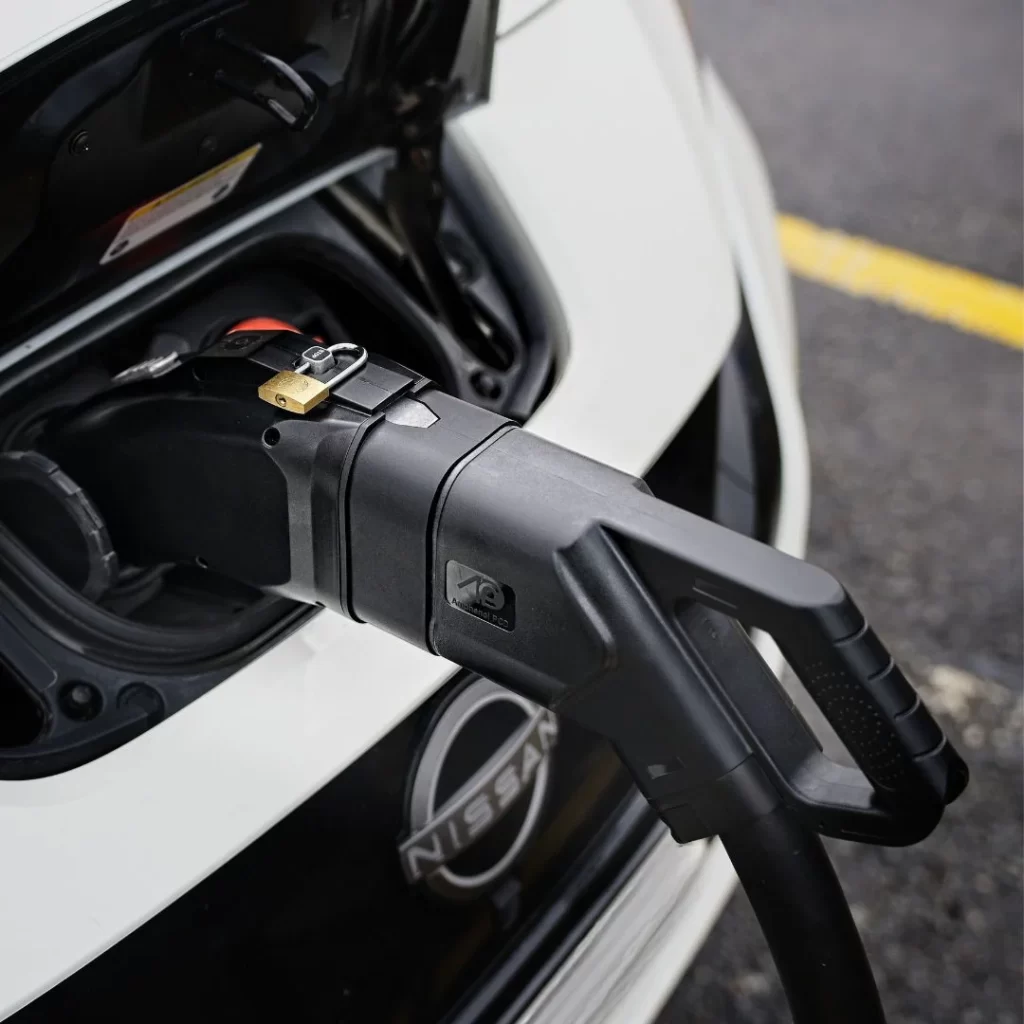
Yes, but it needs a compatible CCS to CHAdeMO adapter.
A CCS charging cable cannot be connected directly to a CHAdeMO car. The connectors are different, and the two charging standards use different communication protocols.
In Europe, CHAdeMO cars normally need a CCS2 to CHAdeMO adapter. The adapter connects the CCS2 cable to the car’s CHAdeMO inlet and manages communication between the charging station and the vehicle.
Why can’t a CHAdeMO car use a CCS charger directly?
CHAdeMO and CCS are separate DC fast-charging standards.
CHAdeMO uses its own connector and communication protocol. European CCS fast chargers use the CCS2 connector. A physical connector that merely changes the plug shape would not be enough.
An active CCS to CHAdeMO adapter contains electronics and firmware. It receives information from the CCS charger and communicates with the vehicle through the CHAdeMO protocol.
The car remains in control of the charging session. It determines how much current it can accept and reduces or stops charging when necessary. CHAdeMO is specifically designed for communication between the vehicle and the DC charger.
Which CHAdeMO cars can use a CCS to CHAdeMO adapter?
Compatibility depends on the adapter and the car.
The Longood CCS2 to CHAdeMO adapter sold by Autonlaturit.com has been tested with vehicles including:
- Nissan Leaf
- Nissan e-NV200
- Lexus UX 300e
- Mitsubishi Outlander PHEV
Check the exact model before buying instead of assuming that every vehicle with a CHAdeMO inlet will work. You can use the compatibility tool on our website autonlaturit.com to check if your specific vehicle is supported.
A CHAdeMO inlet alone does not guarantee compatibility. Vehicle software, charging-system implementation and regional differences can affect how a particular car works with an adapter.
Why would a CHAdeMO driver want to use CCS chargers?
CCS2 is the standard used at most new high-power charging stations in Europe.
Many older 50 kW stations were equipped with both CCS and CHAdeMO connectors. Newer charging hubs often have several CCS charging points but either one CHAdeMO connector or none at all. The European Alternative Fuels Observatory notes that more high-power charging providers are choosing CCS2-only installations.
This can make long-distance travel difficult even when the car itself remains reliable and has enough battery capacity.
An adapter gives a compatible CHAdeMO car access to many CCS locations that would otherwise be unavailable. It can reduce dependence on individual CHAdeMO chargers and provide alternatives when a charger is occupied, broken or located away from the planned route.
At a charging hub with six CCS stalls and one CHAdeMO connector, the adapter may allow the driver to use several additional stalls instead of waiting for the only CHAdeMO plug.
Does the adapter make the car charge faster?
The car determines the charging speed.
Connecting an older Nissan Leaf to a 300 kW CCS charger does not mean that the car will charge at 300 kW. The vehicle only requests the amount of power its battery and charging system can accept.
Charging speed also changes during the session. It can be affected by:
- battery temperature
- state of charge
- battery condition
- the vehicle’s charging curve
- the output available from the charging station
Older Nissan Leaf models typically remain within their normal DC charging range. A 62 kWh Leaf can accept more power under suitable conditions and has reached approximately 70–75 kW with the Longood adapter on compatible chargers.
Some CCS chargers may provide more stable power than an older or heavily shared CHAdeMO unit. The main benefit is still wider charger access rather than guaranteed faster charging.
Is it safe to connect an older car to a high-power CCS charger?
A high-power charger does not automatically send its maximum output into the car.
During DC charging, the vehicle communicates its voltage and current limits. The charger supplies power according to the request it receives. A 40–50 kW car can therefore use a charger rated for much higher power without receiving the charger’s full advertised output.
The adapter must be designed for the voltage and current used by the charging station. The Longood adapter is rated for up to 1,000 volts and 200 amps. It is CE marked and has an IP54 enclosure rating.
Can you still use normal CHAdeMO chargers?
Yes.
The adapter does not modify the vehicle or replace its CHAdeMO inlet. A normal CHAdeMO charging cable can still be connected directly to the car as before.
Use the adapter only when charging from a compatible CCS2 station. If the location has a working CHAdeMO connector, you can choose either option.
This can be useful at older multi-standard chargers. Direct CHAdeMO charging may be the simplest choice when the connector is available, while the adapter provides an alternative at CCS-only locations or when the CHAdeMO side is occupied.
Can the adapter be used with every CCS charger?
Compatibility can vary between individual charging stations.
CCS chargers are made by different manufacturers and run different software versions. Charging networks can also update their authentication, startup and communication processes.
The Longood adapter has been field-tested with chargers from manufacturers and networks including ABB, Kempower, Alpitronic, Tritium and Ionity. It also supports firmware updates through USB.
An individual session can still fail because of a temporary charger fault, communication problem or payment issue. This does not necessarily mean that the car or adapter is incompatible with the whole charging network.
Test the adapter at one or more nearby stations before relying on it during a long journey.
Can you use a Type 2 charger with the adapter?
No.
Type 2 is normally used for AC charging. A CCS to CHAdeMO adapter is designed for DC fast charging.
Although European CCS2 is based partly on the Type 2 connector shape, CCS2 includes additional DC contacts and uses a different charging process.
The adapter cannot be connected to a Type 2 wallbox or a normal public AC charging post. It also does not replace the car’s normal AC charging cable.
Use the vehicle’s existing AC charging equipment at home, at work and at Type 2 charging points. Use the CCS to CHAdeMO adapter only at CCS2 DC fast chargers.
Do you need CCS1 or CCS2?
European fast-charging stations normally use CCS2, also called CCS Combo 2.
CCS1 is a different connector used mainly in North America. A CCS1 adapter will not fit a European CCS2 charging cable.
Imported vehicles and adapters require particular attention. Check both the vehicle’s charging standard and the connector used by local fast chargers before ordering.
For normal European use, the relevant product is a CCS2 to CHAdeMO adapter.
How do you find a suitable charging station?
Select CCS2 or CCS Combo 2 in the filters of your preferred charging map or network app.
The station must offer DC fast charging. A listing that only shows Type 2 AC charging is not suitable.
Before driving to the station, check:
- whether the CCS connector is shown as available
- whether the station is open to your vehicle
- how the charging session is started and paid for
- whether recent users have reported faults
- whether the cable can comfortably reach the car’s charging inlet
The last point can matter with vans or cars whose CHAdeMO inlet is positioned differently from the charging ports on newer CCS vehicles. Park close enough that the cable and adapter are not under tension.
How do you charge through the adapter?
Follow the current instructions supplied with the adapter. The connection sequence can affect whether the charging session starts correctly.
A typical process with the Longood adapter is:
- Make sure the adapter’s internal battery has been charged.
- Connect the adapter to the car’s CHAdeMO inlet.
- Connect the CCS2 charging cable to the adapter.
- Start the session through the charger, payment terminal or charging app.
- Activate the adapter as instructed.
- Check that the car and charger both show an active charging session.
Stop the charging session through the charger or app before disconnecting anything. Wait until the charger releases the CCS connector, then remove the equipment in the order stated in the user manual.
The Longood package includes a charging cable for the adapter, an update cable, a USB drive, a storage bag, a lock and a user manual.
What can cause a charging session to fail?
A failed start can have several causes:
- the charger is temporarily out of service
- the payment or authentication process did not complete
- the connectors were attached in the wrong order
- the adapter’s internal battery is low
- the adapter firmware needs updating
- the CCS cable is not fully inserted
- the car is not ready for DC charging
- the battery is too hot, too cold or already nearly full
- the charger and adapter fail to complete communication
Stop the session before disconnecting anything. Follow the instructions shown by the charger, reconnect the equipment and try again.
Another charging stall at the same location may work even when the first one does not. A different charger manufacturer or network can also be worth trying.
Persistent problems should be reported with the vehicle model, charging-station location, charger manufacturer and any error message shown. Those details make troubleshooting and firmware support easier.
Why are firmware updates important?
An active adapter relies on software as well as hardware.
Charging stations receive updates, and new charger models continue to enter the market. Adapter firmware can be updated to improve startup behaviour and compatibility with different stations.
The Longood adapter can be updated through USB. It is also supported by a manufacturer-independent open-source firmware project, which provides another route for continued development and compatibility improvements.
A fixed-firmware adapter may continue to work normally, but it offers fewer options if a future charger update creates a new communication problem.
What should you check before buying?
Start with confirmed compatibility for the exact vehicle.
Then check the regional connector type, electrical ratings, firmware support, instructions, warranty and availability of customer service.
A CCS to CHAdeMO adapter is an active high-voltage device. The cheapest listing is not automatically the best value if the seller cannot confirm vehicle compatibility, provide software updates or help when a particular charger does not work.
The Longood adapter sold by Autonlaturit.com includes a 30-day satisfaction guarantee, a two-year warranty and customer support for compatibility and charging issues.
Who benefits most from a CCS to CHAdeMO adapter?
The adapter is particularly useful for drivers who:
- use public DC charging regularly
- make longer journeys
- have limited CHAdeMO coverage on their routes
- rely on a single CHAdeMO connector at local charging hubs
- want to keep an otherwise suitable CHAdeMO car for several more years
- need more backup options during work or family travel
A driver who almost always charges at home and rarely travels beyond the car’s range may use the adapter less often.
Even occasional use can be valuable when the alternative is a long detour, a queue at the only CHAdeMO charger or an unavailable charging stop.
Bottom line
A CHAdeMO car can charge at a CCS fast charging station through a compatible active adapter.
The adapter translates communication between the CCS charger and the CHAdeMO vehicle. The car remains responsible for setting its charging limits, so a high-power station will not force more power into the battery than the vehicle requests.
Compatibility should be confirmed for the exact car. European drivers also need to choose a CCS2 adapter rather than CCS1.
The adapter does not increase battery capacity or remove the vehicle’s charging limits. It gives a compatible CHAdeMO car access to a much larger selection of DC fast chargers.