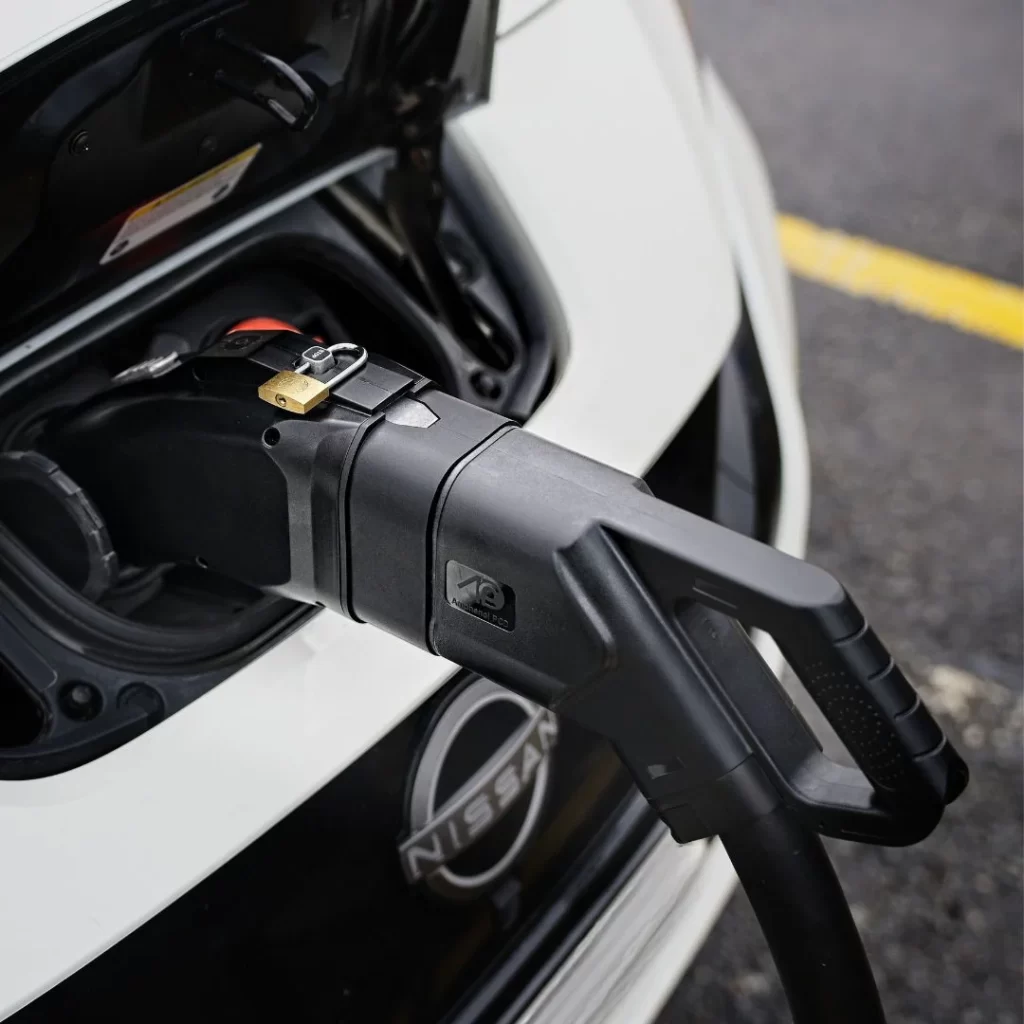

Fast charging a Nissan Leaf is straightforward, but a few habits can make road trips noticeably easier.
Charging speed is not constant. It changes with battery state of charge, battery temperature, the charger itself and the particular Leaf model. Nissan also notes that fast charging slows as the battery fills and can take longer when the battery is especially hot or cold.
Here are five practical tips for getting more out of fast charging without relying on unrealistic charging-speed expectations.
1. Don’t wait until the battery is almost empty before looking for a charger
Arriving at a charger with a relatively low state of charge can be useful because the battery generally accepts power more readily when it is not already close to full.
That does not mean you should deliberately run the battery down as far as possible.
Leave enough reserve for unexpected situations. A charger may be occupied, temporarily unavailable or harder to access than expected. Weather, motorway speed and elevation can also change energy consumption during the journey.
The safest approach is to plan the next charging stop before the remaining range becomes uncomfortable.
This matters even more with CHAdeMO-equipped Leafs because there may be fewer suitable fast chargers along a route than there are CCS chargers.
A charging stop with another usable station nearby is often better than one that leaves no backup.
2. Don’t automatically fast charge to 100%
Fast charging becomes slower as the battery fills.
Nissan specifically notes that the Leaf’s fast-charging rate decreases as the battery’s state of charge rises.
On a road trip, this means waiting for the last part of a charge can sometimes take longer than it is worth.
If you already have enough energy to reach the next convenient charger or your destination with a sensible reserve, continuing to charge may simply extend the stop.
For example, two shorter charging stops can sometimes fit a journey better than one very long stop where you wait for the battery to approach full.
There is no single percentage that every Leaf driver should use as a departure point. Battery size, battery condition, weather, driving speed and the distance to the next charger all matter.
Watch the charging power and the range you actually need rather than treating 100% as the target for every fast-charging session.
Charging to full can still make sense when you need the range. It just does not need to be the default at every stop.
3. Pay attention to battery temperature on long trips
Battery temperature has a major effect on Leaf fast charging.
Nissan states that fast charging can take longer when the lithium-ion battery is either hot or cold. It also warns that repeated fast charging can raise battery temperature enough for the car’s battery protection system to reduce charging performance. Sustained high-speed driving and hot ambient temperatures can contribute to the same effect.
This is particularly relevant on long motorway journeys with several fast-charging stops.
The first charging session of the day may therefore behave differently from a later session after hours of driving and previous fast charges.
Keep an eye on the battery temperature display if your Leaf provides one.
If the battery is already unusually hot, another fast charge may take longer than expected. Driving slightly more moderately between stops can also reduce energy consumption and may help avoid adding unnecessary heat.
Nissan recommends avoiding sustained high battery temperatures and minimizing repeated fast charging where practical as part of its guidance for maximizing battery life.
This does not mean that fast charging should be avoided whenever you need it. It means that several fast charges in one day should not be expected to behave identically.
4. Choose the charger for your car, not for the biggest number on the screen
A 300 kW charger will not make a Nissan Leaf charge at 300 kW.
The car controls how much power it can accept. The charger can offer more, but the Leaf requests power according to its own charging system, battery condition, temperature and state of charge.
Different Leaf versions also have different charging capabilities.
Nissan’s own documentation, for example, specifies different maximum fast-charging capabilities for 40 kWh and larger-battery versions.
For the driver, the exact headline rating of the station is therefore often less important than:
- whether the charger is compatible with the car
- whether it is working
- whether there are several charging stalls
- whether another charger is available nearby
- whether the site is conveniently located on the route
A reliable charger in the right place is usually more useful than choosing a station solely because it advertises the highest possible power.
The same principle applies when using a CCS to CHAdeMO adapter. The adapter gives the Leaf access to compatible CCS chargers, but it does not override the car’s own charging limits.
5. Give yourself more than one fast-charging option
One of the biggest problems on a Leaf road trip is not necessarily charging speed. It is having too few suitable chargers to choose from.
Many CHAdeMO-equipped Leafs are still perfectly usable cars, but European public fast charging has increasingly shifted toward CCS.
A compatible CCS to CHAdeMO adapter can give an older Leaf additional charging options instead of making every trip depend entirely on native CHAdeMO stations.
The Longood CCS2 to CHAdeMO adapter sold by Autonlaturit.com has been tested with Nissan Leaf 24, 30, 40 and 62 kWh models. It allows compatible Leafs to use supported CCS2 fast chargers while the car continues to control the charging power it accepts.
This can be especially useful at larger charging hubs. Instead of depending on a single CHAdeMO connector, the driver may have several compatible CCS stalls available.
An adapter is still worth testing before a long trip.
Charging stations use different hardware and software, and an individual station can occasionally fail to start a session. The Longood adapter supports USB firmware updates, which can be used to improve compatibility when charger behaviour changes.
If you travel regularly, keep a few alternative charging locations in mind rather than planning the journey around one specific charger.
What should you expect from Nissan Leaf fast charging?
Expect the charging speed to change during the session.
A Leaf may initially charge well and then reduce power as the battery fills. A cold battery can charge more slowly. A hot battery after motorway driving and repeated fast charges can also reduce charging performance.
The charger’s advertised maximum power does not tell you what the car will actually receive.
None of these behaviours necessarily indicate a fault. They are normal parts of how the vehicle manages charging. Nissan explicitly states that charging time depends on factors including battery temperature, charger condition and charging conditions.
Bottom line
The five most useful fast-charging habits for Nissan Leaf owners are simple:
- Plan the next charger before the battery becomes critically low.
- Do not wait for 100% unless you actually need the extra range.
- Watch battery temperature during trips with repeated fast charging.
- Choose chargers based on usefulness and reliability, not only their maximum kW rating.
- Give yourself backup charging options, including compatible CCS chargers if you use a CCS to CHAdeMO adapter.
A little planning usually saves more time than chasing the highest possible charging number.