You plug your Nissan Leaf into a fast charger at 20%.
At first, the charging speed looks good. The battery percentage climbs steadily and everything feels exactly as it should.
Then, as the battery gets fuller, something changes.
The charging speed starts to fall. Each additional percentage point takes longer. Eventually you may find yourself sitting at the charger waiting for the last bit of range while the car is adding energy much more slowly than it did earlier in the session.
So when should you actually stop charging a Nissan Leaf?
For most road trips, charging to 100% at every fast-charging stop is rarely the quickest strategy. A better approach is usually to charge until you have comfortably enough energy to reach the next suitable charger, then continue driving.
Around 80% is a useful rule of thumb because charging generally becomes less time-efficient as the battery gets fuller. But 80% is not a magic number, and the best time to unplug can sometimes be earlier or later.
Understanding the Leaf’s charging curve makes that decision much easier.
What is a Nissan Leaf charging curve?
A charging curve simply describes how much charging power the car accepts at different battery levels.
The important thing to understand is that a Leaf does not charge at one fixed speed from empty to full.
Even if you connect the car to a charger capable of delivering 50 kW or more, the Leaf decides how much power it wants at any particular moment. The charging station can offer power, but the car controls what actually goes into the battery.
When the battery is relatively low and conditions are favourable, the car can generally accept power more quickly. As the battery becomes fuller, charging power eventually starts to decrease.
This reduction is often called tapering.
And it is the reason why charging from, for example, 20% to 60% can feel much quicker than waiting for the final part of a nearly full battery.
Why does charging slow down as the battery fills?
A lithium-ion battery cannot simply accept maximum charging power all the way to 100%.
As the battery approaches a high state of charge, the car gradually manages charging more conservatively. This is normal behaviour and is controlled automatically by the vehicle.
You do not need to manage the battery manually or worry when the number on the charging station starts falling.
The important point for a driver is what that slowdown does to your journey.
Early in the charging session, waiting another ten minutes may add a useful amount of driving range. Later in the session, the same ten minutes may add much less.
That is why the fastest road-trip strategy is not necessarily to leave every charger with the fullest possible battery.
Is 80% the best time to stop charging?
Often, but not always.
There is a reason you see 80% mentioned so often when people talk about EV fast charging. Nissan itself has traditionally quoted rapid-charging times for the older Leaf using a 20% to 80% window.
It is a useful benchmark because it covers a large portion of the battery without spending too much time near full charge.
But you should not treat 80% as a rule that must always be followed.
If your next charger is only a comfortable distance away, leaving at 65% or 70% may be faster.
If the next reliable charger is much farther away, charging to 85% or 90% may be the sensible choice.
The right question is “Do I have enough range to reach my next stop with a comfortable margin?”
Why stopping earlier can make a road trip faster
Imagine that you have enough energy at 72% to reach another fast charger comfortably.
You could remain plugged in until 90%, giving yourself more range.
But if charging power is already falling, those additional percentage points may take disproportionately longer than the earlier ones.
Instead, you could unplug, drive to the next charger and arrive with a lower battery again. You are then back in a more favourable part of the charging session.
Over a long journey, repeating shorter charging stops can sometimes save time compared with repeatedly waiting for a high state of charge.
This does not mean you should always leave as soon as the charging speed drops slightly.
There is a trade-off. Every extra stop also takes time to reach, park, connect and start.
The goal is not to stop as often as possible. It is to avoid spending unnecessary time charging slowly when you already have enough energy to continue.
Does every Nissan Leaf have the same charging curve?
No, and this is where overly precise advice can become misleading.
The Nissan Leaf has been sold with several battery sizes over the years. The common CHAdeMO-equipped versions include 24 kWh, 30 kWh, 40 kWh and 62 kWh batteries.
They do not all behave exactly the same when fast charging.
A 62 kWh Leaf has a much larger battery than an early 24 kWh model, so percentages also represent very different amounts of energy. Charging behaviour can vary between versions, battery conditions and individual charging sessions.
For example, Nissan’s official figures for later CHAdeMO Leafs quote around 60 minutes for a 40 kWh Leaf to charge from 20% to 80% on a 50 kW rapid charger, and around 90 minutes for the 62 kWh Leaf.
The useful lesson is not to memorise one universal Leaf charging curve.
Watch what your own car is doing.
Battery temperature can change the picture
State of charge is only part of the story.
Battery temperature can have a major effect on how quickly a Nissan Leaf fast-charges.
Nissan specifically notes that charging time depends on factors including battery temperature and ambient temperature. The company also warns that successive rapid-charging sessions can take longer if the battery becomes hot enough for the car’s battery protection systems to intervene.
This is particularly relevant on long summer journeys.
Your first fast charge of the day may go smoothly. After hours of motorway driving and another rapid charge, the next session may be noticeably slower.
Cold conditions can affect charging performance too.
So if your Leaf charged differently yesterday, it does not necessarily mean something is wrong with the charger or the battery.
The charging curve is not a fixed line that the car follows identically every time.
Should you wait for 100% at a fast charger?
Sometimes you genuinely need the range.
Perhaps the next charging opportunity is far away. Maybe you are driving into a rural area with few chargers, towing is not relevant here, weather conditions are poor, or you simply want a larger safety margin.
In that situation, charging beyond 80% can be completely reasonable.
What usually does not make sense is charging to 100% simply because 100% feels like the natural point to stop.
A fast charger is most useful when it adds the energy you need quickly. Once charging has slowed considerably, staying connected should have a reason.
If you are five minutes from home, waiting at an expensive public fast charger for the battery to crawl towards 100% is usually unnecessary.
If that extra energy is what gets you safely to the next reliable charger, the same wait can be worthwhile.
Context matters more than the percentage itself.
Look at charging power, not only battery percentage
One of the easiest ways to improve your Leaf road-trip strategy is to pay attention to the charging station screen.
Most DC chargers show the current charging power in kilowatts.
You do not need to know exactly what power your Leaf should be accepting at every percentage. Just notice the direction.
If the car has been charging well and the power has now fallen significantly, ask yourself whether you actually need more energy.
If the answer is no, that may be a good time to leave.
This is more useful than blindly following a fixed rule such as “always charge to 80%” because real charging sessions vary.
You may have one session where continuing past 80% is perfectly sensible and another where the combination of a hot battery and high state of charge means very little range is being added for the time you are waiting.
The charger is already showing you that information.
Charger availability changes the best strategy
There is another factor Leaf drivers have to consider that owners of many newer EVs do not.
Where is the next charger you can actually use?
Older European Nissan Leafs use CHAdeMO for DC fast charging. The problem is that modern European charging infrastructure is increasingly centred around CCS2.
That can encourage a Leaf driver to stay at a CHAdeMO charger longer than would otherwise make sense.
If you know the next compatible charger is 150 kilometres away, you naturally want a bigger battery margin before leaving. If there were several compatible chargers along the route, you might comfortably unplug much earlier.
In other words, charging strategy is partly an infrastructure problem.
The more charging locations your car can use, the easier it becomes to take advantage of the useful part of the charging curve.
This is where a CCS2 to CHAdeMO adapter can help
A CCS2 to CHAdeMO adapter does not change the Leaf’s charging curve.
It does not make the battery accept unlimited power, remove temperature-related charging limits or make an older Leaf behave like a new CCS-equipped EV.
What it can change is your choice of charging stops.
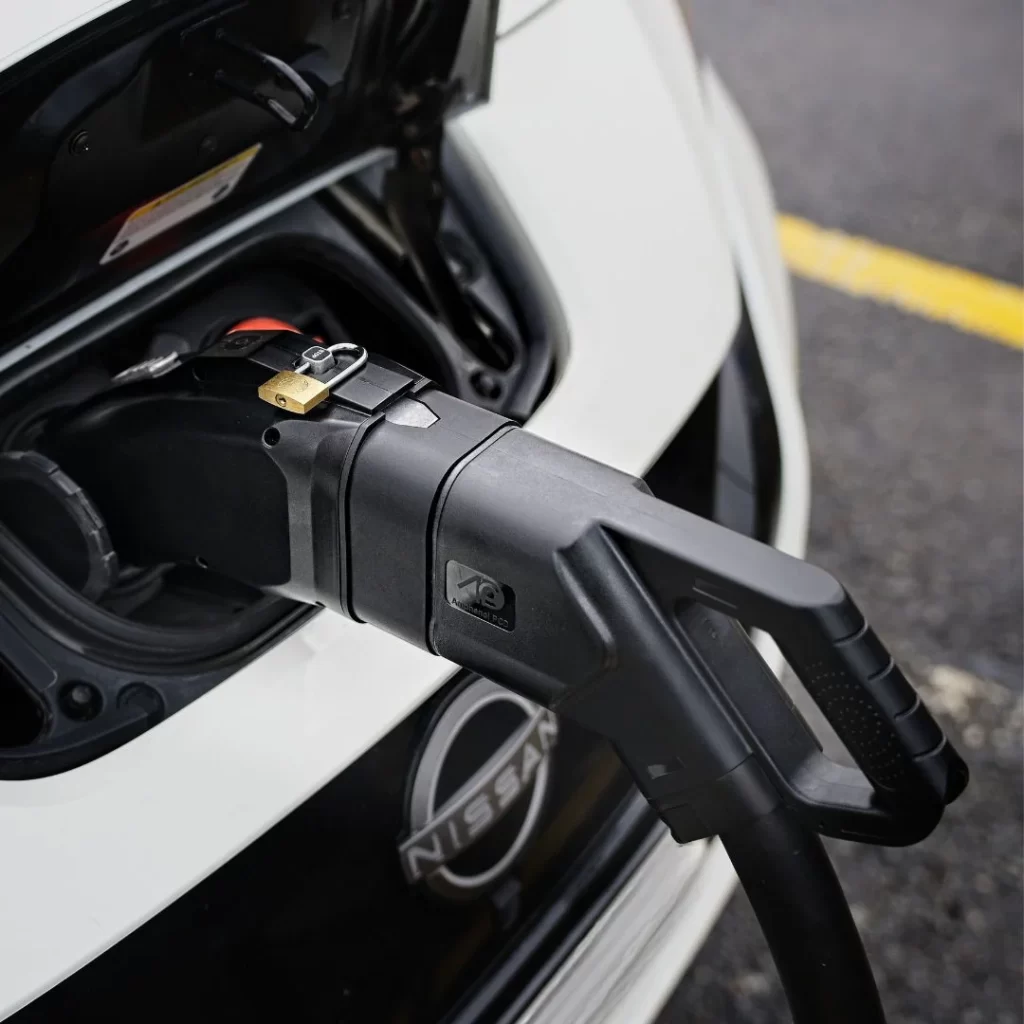
A compatible adapter allows a CHAdeMO-equipped Leaf to use many CCS2 fast chargers. For European Leaf drivers, that can open up charging locations that the car could not otherwise use.
The Longood CCS2 to CHAdeMO adapter available from Autonlaturit.com has been tested with 24, 30, 40 and 62 kWh Nissan Leaf models.
That wider charger access can also change how you use the charging curve.
If you know there are several compatible CCS2 charging locations ahead, you may no longer need to sit at the only available CHAdeMO charger waiting for 90% simply for peace of mind.
You can charge what you need and continue.
Does the adapter make the Leaf charge faster?
The adapter should not be thought of primarily as a charging-speed upgrade.
The Leaf still determines how much charging power it accepts.
If the battery is hot, nearly full or otherwise limiting charging power, connecting through a CCS2 to CHAdeMO adapter does not remove those limits.
Where it can make a practical difference is charger choice.
Some older CHAdeMO infrastructure is limited or increasingly difficult to find, while modern CCS2 sites may have several charging stalls at the same location.
Having access to more stations means you can plan around the Leaf rather than planning the entire journey around the location of a few CHAdeMO connectors.
That is particularly useful if you prefer shorter, more efficient charging stops.
The charging curve itself stays with the car. Your options around that curve become much better.
What about the new Nissan Leaf?
The advice in this article mainly applies to the older Nissan Leaf generations equipped with CHAdeMO.
The newest generation Leaf sold in Europe is different.
It uses CCS2 fast charging from the factory and has a newer charging system, so its charging behaviour should not be confused with the 24, 30, 40 and 62 kWh CHAdeMO Leafs discussed here.
If you own the latest-generation Leaf, you do not need a CCS2 to CHAdeMO adapter.
For the large number of older Leafs still on European roads, however, understanding the car’s charging curve remains especially useful because charging speed and charger availability both influence how long a journey takes.
So when should you unplug your Nissan Leaf?
For a road trip, the best time to stop fast charging is usually when you have enough energy to reach your next suitable charger with a sensible reserve and continuing to charge is becoming noticeably less time-efficient.
That might be around 80%.
It might be 70%.
Sometimes it might be 90%.
There is no single percentage that works for every Leaf, every journey and every charging session.
Think of 80% as a useful reference point rather than a target you must hit.
Watch the battery percentage, look at the current charging power, consider battery temperature and know where your next reliable charging stop is.
Once you start doing that, the Leaf’s charging curve stops being an abstract technical concept.
It becomes a practical tool.
And if limited CHAdeMO availability is forcing you to charge higher than you really need, expanding your options with a CCS2 to CHAdeMO adapter can make that strategy much easier to use.
The goal is not to leave the charger with the fullest battery.
It is to get to your destination with the least unnecessary waiting.