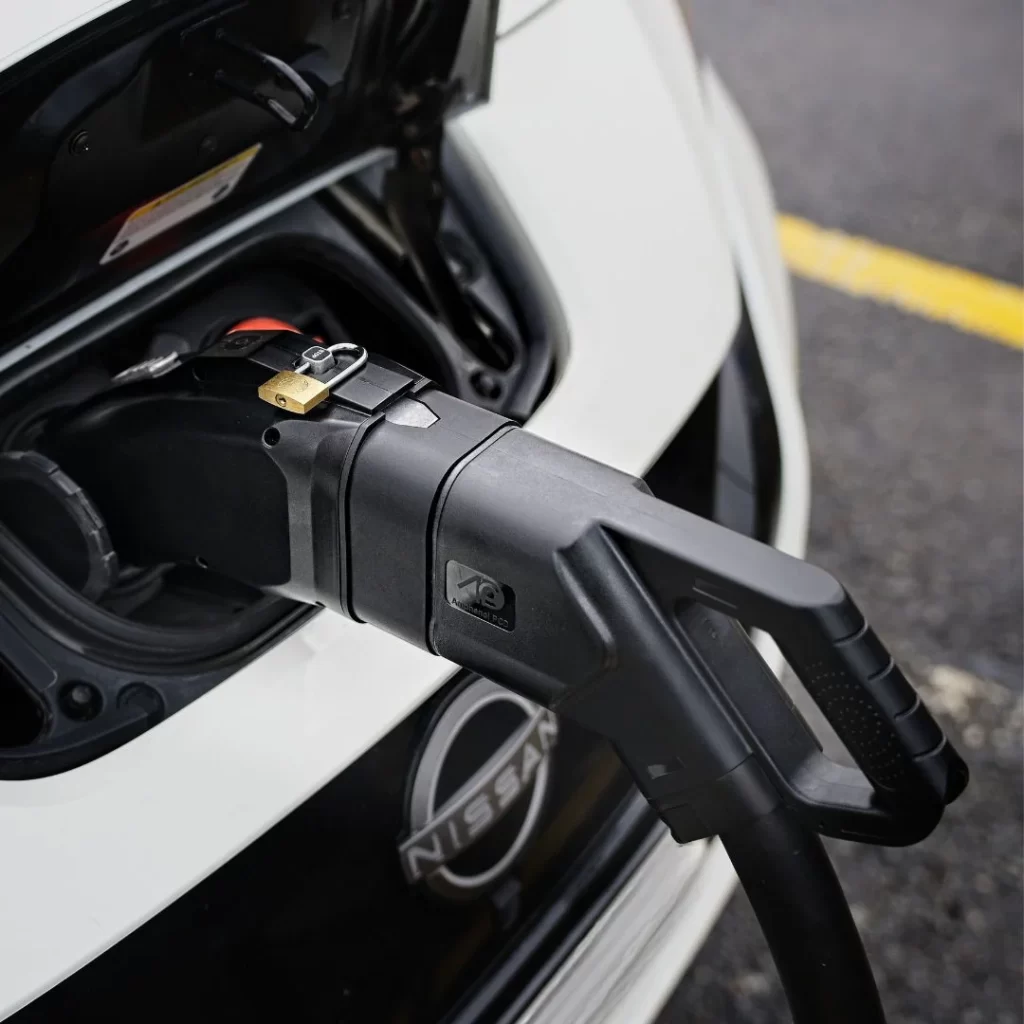
You are planning a long trip in a Nissan Leaf and the route needs more than one fast-charging stop.
Then the obvious question appears: how many times can you actually fast-charge a Leaf in one day?
The short answer is that there is no fixed daily limit such as one, two or three fast charges.
Nissan’s own guidance for CHAdeMO-equipped Leaf models states that quick charging is possible several times a day. The important limitation is not a counter that resets at midnight. It is battery temperature.
If the battery becomes too warm, the Leaf can reduce fast-charging power to protect it. Nissan also warns that repeated rapid-charging sessions in a short period can take longer when battery-protection systems are activated.
So yes, you can fast-charge a Nissan Leaf several times during the same day. But the second, third or later session may not look like the first one.
This guide focuses mainly on the CHAdeMO-equipped Nissan Leaf generations with 24, 30, 40 and 62 kWh batteries. The newest Leaf generation uses CCS2 charging from the factory and is a different case.
Is there a maximum number of fast charges per day?
No fixed maximum is published for normal use.
This matters because old advice about the Leaf is still repeated online as if the car has a strict daily fast-charging allowance.
It does not work that way.
Nissan’s Leaf owner’s manuals state that quick charging is possible several times a day. The car monitors battery conditions and can limit charging power when necessary.
If you need two fast charges, you can fast-charge twice. If the journey needs another stop later, the car does not refuse simply because you have already charged earlier that day.
What matters is what has happened to the battery during the journey.
Why can the second or third fast charge be slower?
Fast charging adds energy to the battery, but it can also raise battery temperature.
Driving conditions, outside temperature, battery state of charge and previous charging sessions all influence what happens next.
You might arrive at the first charger with favourable battery conditions and see a good charging rate. Later in the day, after more motorway driving and another fast charge, the Leaf may accept less power.
That does not necessarily mean the charger is faulty.
Nissan specifically notes that successive rapid charging can take longer if battery temperature activates the vehicle’s battery safeguarding technology.
The car is doing what it was designed to do.
Does fast charging several times damage the battery?
It helps to separate two different questions.
Can you fast-charge several times in one day? Yes.
Should repeated DC fast charging be your normal charging routine if you have easy access to AC charging? Nissan’s guidance is more cautious.
Nissan recommends normal charging for usual charging and says quick charging should be minimized to help prolong lithium-ion battery life.
That does not mean a road trip with several fast charges is something to fear. Fast charging exists because drivers sometimes need to add energy quickly away from home.
The sensible approach is simply to use fast charging when it is useful, and home or destination AC charging when time is not important.
What actually limits repeated fast charging?
For most Leaf road trips, battery temperature is the practical limit.
There is no useful rule such as “three charges are safe but four are too many” because conditions are not identical from one day to another.
A cool day, moderate driving and shorter charging sessions can create a very different situation from high-speed motorway driving in warm weather followed by repeated long fast charges.
The Leaf monitors the battery and protects itself. If battery temperature becomes high, charging power can be reduced.
For the driver, the lesson is simple: watch what the car and charger are telling you rather than counting sessions.
If your third stop is much slower than your first, battery temperature may be part of the reason.
Does charging to 100% make a long trip slower?
Often, yes.
Fast charging generally becomes less time-efficient as the battery gets fuller. If you stay at each charger until the battery is nearly full, you can spend a lot of time waiting for the final part of the charge.
This is why road-trip charging is usually about reaching the next suitable charger, not reaching 100% at every stop.
If 70 or 80% gives you a comfortable margin to the next charger, continuing to wait may not help much.
There are exceptions. If the next reliable charger is far away, charging higher can be the right choice.
But on a route with plenty of charging options, shorter sessions can make a full day of Leaf driving easier and faster.
Why charger availability matters more than you might think
Older European Leafs use CHAdeMO for DC fast charging.
That creates a second limitation on long journeys. Even if the car is ready for another fast charge, you still need a suitable charger.
A route may have many modern fast-charging locations but only a small number of CHAdeMO connectors.
That can encourage Leaf drivers to charge higher than necessary. If the next CHAdeMO charger is far away or you are unsure whether it will be available, sitting at the current charger until 90% can feel safer than leaving at 70%.
In that situation, charging strategy is being shaped by the connector network as much as by the battery.
More usable charging locations give you more freedom to leave earlier.
This is where a CCS2 to CHAdeMO adapter becomes useful
A CCS2 to CHAdeMO adapter does not let the Leaf fast-charge more times per day.
It does not cool the battery or remove the car’s charging safeguards.
What it can do is make repeated charging stops much easier to plan.
A compatible adapter allows a CHAdeMO-equipped Leaf to use many CCS2 fast chargers in Europe. The Longood CCS2 to CHAdeMO adapter sold by Autonlaturit.com has been tested with 24, 30, 40 and 62 kWh Nissan Leaf models.
For a Leaf driver, the benefit is not simply access to another connector. It means you may no longer need to stretch every charging session because the next CHAdeMO charger is a long distance away.
More charger choice can support shorter, better-timed stops.
Does a CCS2 charger make repeated charging faster?
Not automatically.
Connecting a Leaf to a high-power CCS2 station through an adapter does not override the limits of the car.
The Leaf still decides how much power it accepts. If battery temperature or state of charge is limiting the session, that limitation remains.
The adapter solves an infrastructure problem, not a battery-temperature problem.
That is also why it makes sense for long-distance Leaf ownership. You are not trying to turn an older Leaf into a different car. You are giving it more places where it can use the fast-charging capability it already has.
On a route with several CCS2 hubs, that extra flexibility can be valuable even when the charging speed itself does not increase.
Should you stop if the next fast charge becomes very slow?
First ask whether you already have enough energy to continue.
If charging power has fallen significantly and you can comfortably reach the next suitable charger, staying connected may simply add waiting time.
If you still need the energy, continue charging. The car will manage its own protective limits.
What you should not assume is that moving to another charger will automatically restore the speed you saw earlier in the day. If the Leaf itself is limiting charging because of battery conditions, changing chargers may not solve it.
Does the weather change how many times you can fast-charge?
Weather can change how repeated charging feels, but it still does not create a fixed daily limit.
Nissan lists battery temperature and ambient temperature among the factors that affect rapid-charging time.
Warm conditions can make battery temperature more important during repeated fast charging. Cold conditions can slow charging too.
There is little value in trying to invent one exact temperature or one exact number of charging sessions at which performance will change. Different cars, journeys and conditions can behave differently.
Instead, pay attention to the battery temperature information available in the car and to changes in charging power.
A route that was easy on a mild day may simply need more charging time in different conditions.
What is a sensible strategy for a full day of Leaf driving?
Start with the amount of energy you actually need, not with a target number of fast charges.
Begin the trip with a useful charge, choose reliable charging locations and avoid staying connected much longer than necessary.
Watch battery temperature and charging power as the day progresses. If later sessions become slower, accept that the car may be protecting the battery and adjust your expectations.
For a CHAdeMO-equipped Leaf in Europe, having more possible charging locations can make this strategy much easier. A CCS2 to CHAdeMO adapter can expand your options so you are not planning the entire day around a few remaining CHAdeMO connectors.
So how many times can you fast-charge a Nissan Leaf in one day?
There is no fixed daily number.
Nissan states that quick charging is possible several times a day on CHAdeMO-equipped Leaf models. The practical limitation is that battery temperature and other charging conditions can reduce charging power during successive sessions.
That means two, three or more fast-charging stops can be part of a long journey. What you should not expect is for every session to be equally fast.
For everyday use, Nissan recommends normal charging as the usual charging method and advises minimizing quick charging to help prolong battery life.
For road trips, however, fast charging is there to be used when you need it.
Plan around the energy you need, watch how the car behaves and avoid waiting for unnecessary extra charge when you already have enough range to continue.
And if finding enough CHAdeMO chargers is what makes repeated stops difficult, a compatible CCS2 to CHAdeMO adapter can solve that part of the problem by opening access to many more fast-charging locations.
The Leaf decides how quickly it can accept power.
Your job is to give yourself enough good places to plug in.