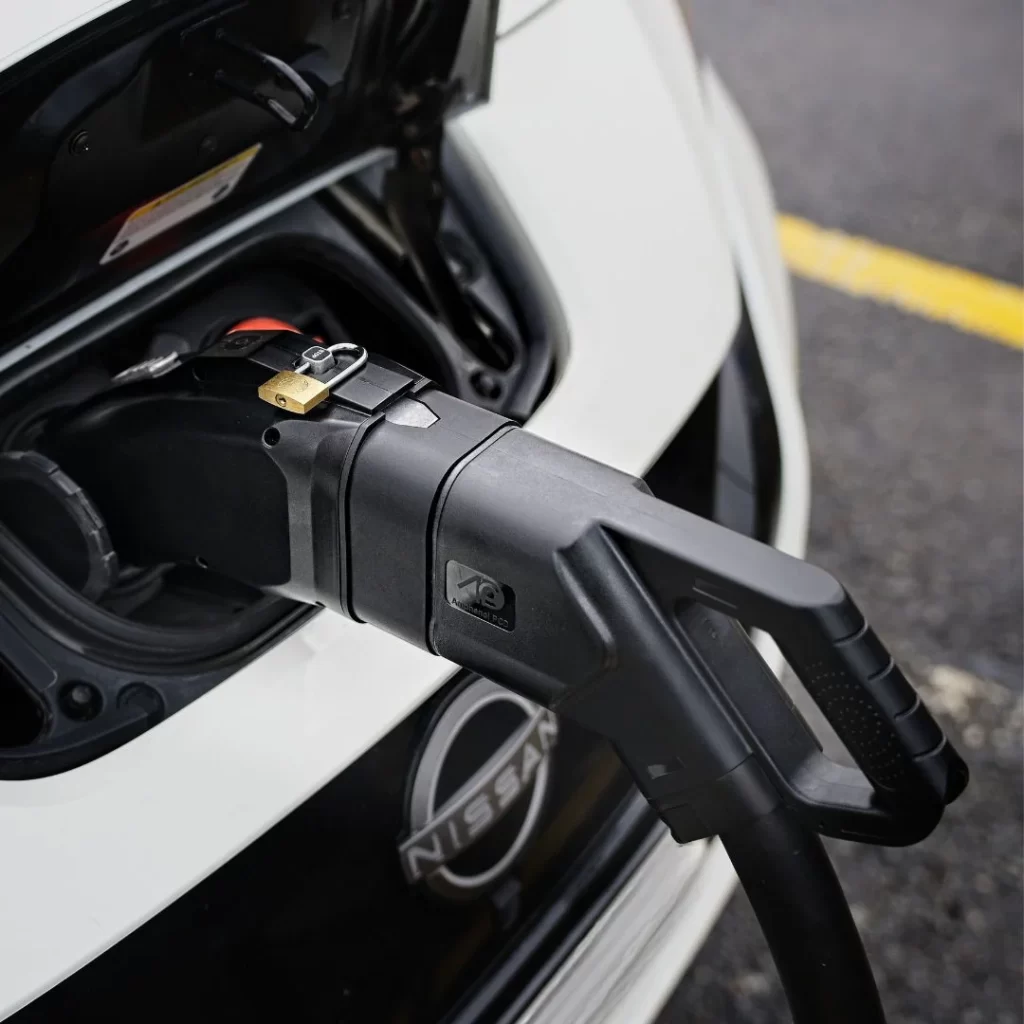
A CCS to CHAdeMO adapter enables fast charging for CHAdeMO-equipped vehicles, with actual speeds depending on the adapter, charging station, and your vehicle’s capabilities. In real-world use, performance is generally comparable to native CHAdeMO fast charging, offering practical and reliable power for both daily driving and longer journeys.
In some cases, the adapter can even allow compatible vehicles to charge at higher power levels at CCS fast charging stations than standard CHAdeMO units typically provide, when the car’s battery system supports it.
What charging speeds can you actually achieve with a CCS to CHAdeMO adapter?
The adapter acts as a protocol translator between the CCS charging infrastructure and your CHAdeMO vehicle. When you connect to a 150 kW CCS charger, for example, the adapter doesn’t simply pass through all that power. Instead, it negotiates a safe charging rate that respects both the adapter’s internal 75 kW limit and your vehicle’s charging specifications.
In normal use, the final charging power is always determined by the car’s own battery management system — the adapter only steps in to limit power if the vehicle were to request more than 75 kW, which can occur with the 62 kWh Leaf in rare optimal conditions.
In real-world conditions, CHAdeMO vehicles like the Nissan Leaf typically accept between 40 and 50 kW anyway, regardless of whether you’re using a native CHAdeMO charger or a CCS adapter. The Leaf e+ (62 kWh) can reach higher peaks in ideal situations, and with the adapter its maximum is effectively capped at around 75 kW — which aligns well with the car’s own upper capability. The charging station and vehicle communicate through the adapter to establish the optimal charging rate, ensuring safe and efficient power delivery throughout the session.
Temperature also plays a role in determining actual charging speeds. Both the adapter and your vehicle’s battery management system monitor thermal conditions and may reduce power output if components become too warm. Likewise, a cold battery will prevent the car from accepting high power until it warms up. These protective behaviours ensure long-term reliability and safety.
Why doesn’t a CCS to CHAdeMO adapter charge as fast as native CCS?
CCS to CHAdeMO adapters charge more slowly than native CCS because they respecting the CHAdeMO vehicle’s technical limitations. CCS charging stations can deliver up to 350 kW, but CHAdeMO vehicles were never designed to accept such high power levels, typically maxing out at 50 to 100 kW depending on the model.
The protocol conversion process itself requires careful management. CCS uses a more complex communication system than CHAdeMO, involving multiple handshake stages and safety verification steps. The adapter must translate these messages accurately whilst maintaining strict safety margins. This translation process, combined with thermal management requirements, only becomes a practical limitation at charging powers above 75 kW — a scenario that applies solely to the 62 kWh Leaf e+, as other Leaf models cannot request higher speeds.
Safety considerations are paramount in adapter design. Engineers build in protective margins to account for various charging scenarios, cable qualities, and environmental conditions. These safety buffers ensure reliable operation across thousands of charging sessions without risking damage to your vehicle’s battery or charging system.
Fundamentally, the adapter is designed to work within CHAdeMO vehicle specifications rather than pushing towards CCS power levels. Your CHAdeMO vehicle’s battery management system and charging hardware were engineered for specific power inputs, and the adapter respects these design parameters to ensure safe, reliable charging that protects your vehicle’s long-term battery health.
How long does it take to charge a Nissan Leaf with a CCS to CHAdeMO adapter?
Charging a Nissan Leaf from 20% to 80% with a CCS to CHAdeMO adapter typically takes 30 to 50 minutes, depending on your Leaf’s battery size and generation. The 40 kWh Leaf models generally complete this charging range in about 30 to 40 minutes, whilst the 62 kWh variants require approximately 45 to 50 minutes under optimal conditions.
These charging times closely mirror what you would experience at a native CHAdeMO charging station. The adapter doesn’t slow down your charging sessions because the limiting factor is usually your Leaf’s own charging acceptance rate rather than the adapter itself. Earlier Leaf models accept around 40 to 50 kW, whilst 62 kWh Leaf e+ can handle slightly higher rates.
Battery temperature significantly affects charging duration. A cold battery charges more slowly because the battery management system protects the cells by limiting power input until they warm up. Similarly, if you’ve just completed a long motorway journey and the battery is warm, you might see slightly faster initial charging speeds. The Leaf’s sophisticated battery management system constantly adjusts charging rates to optimise both speed and long-term battery health. The car also includes a handy battery temperature gauge in the instrument cluster, allowing you to check whether the pack is near its upper or lower limits.
Your current state of charge also influences charging speed. Charging is fastest between 20% and 60%, then gradually slows as you approach 80%. This charging curve is normal for lithium-ion batteries and helps protect battery longevity. Most drivers find that charging to 80% provides the best balance between charging time and driving range for journey planning.
The CCS charger’s available power output matters too. If you connect to a busy charging station where multiple vehicles are sharing power, or to an older CCS unit with lower output, your charging time may extend slightly. However, even a 50 kW CCS charger provides adequate speed for practical charging sessions with your adapter.
What factors affect your charging speed when using an adapter?
Your actual charging speed when using a CCS to CHAdeMO adapter depends on several interacting variables, with the most significant being the CCS charger’s power output, your vehicle’s battery acceptance rate, battery temperature, and your current state of charge. Understanding these factors helps you predict charging times and optimise your charging strategy.
The CCS charging station’s maximum output sets the upper limit for available power. A 150 kW CCS charger can potentially deliver more power than a 50 kW unit, but your actual charging speed will still be constrained by your vehicle’s acceptance rate and the adapter’s specifications. Most modern CCS stations provide adequate power for optimal adapter charging speeds.
Your vehicle’s battery acceptance rate is often the primary limiting factor. Nissan Leaf models, for example, typically accept between 40 and 50 kW regardless of how much power the charging station can provide. This vehicle-side limitation means that connecting to a 350 kW CCS charger won’t charge your car any faster than using a 100 kW station.
However, for newer Nissan Leaf models and other CHAdeMO vehicles capable of accepting higher charging currents, most CCS–CHAdeMO adapters allow them to take full advantage of what their battery system supports. The 62 kWh Nissan Leaf can theoretically peak close to 100 kW, but in real-world conditions it typically reaches around 70–80 kW. With a CCS–CHAdeMO adapter, charging is capped at approximately 75 kW — meaning the Leaf e+ can still reach its practical peak when connected to a sufficiently powerful CCS fast charger.
Battery temperature profoundly influences charging performance. Cold batteries charge slowly because the battery management system protects the cells from damage. Warm batteries (but not hot ones) typically accept power more readily. Extremely hot batteries may also charge slowly as the system implements protective measures. Ambient weather conditions therefore directly affect your charging experience.
State of charge creates a natural charging curve. Charging is fastest when your battery is between 20% and 60%, then gradually tapers as you approach 80%. This tapering protects battery health and is managed automatically by your vehicle’s systems. Planning to charge within this optimal range helps minimise charging time during journeys.
If you’re considering a CCS to CHAdeMO adapter for your electric vehicle, we can help you understand how it will perform with your specific car model and charging needs. Our experience with hundreds of CHAdeMO drivers across Europe means we can provide practical guidance tailored to your situation, ensuring you get a reliable charging solution that works for your daily driving.