If you drive an older Nissan Leaf in Europe, you’ve probably noticed the trend: new fast-charging sites are increasingly built around CCS, while CHAdeMO connectors are fewer and sometimes tucked away as a single plug on the edge of a station.
The Leaf launched in an era when CHAdeMO was one of the established DC fast-charging standards, especially among Japanese manufacturers. Nissan stayed with it across Leaf generations, even as Europe increasingly standardised on CCS for new fast-charging infrastructure.
So the big question is: can you take a CHAdeMO Leaf and use the modern CCS chargers?
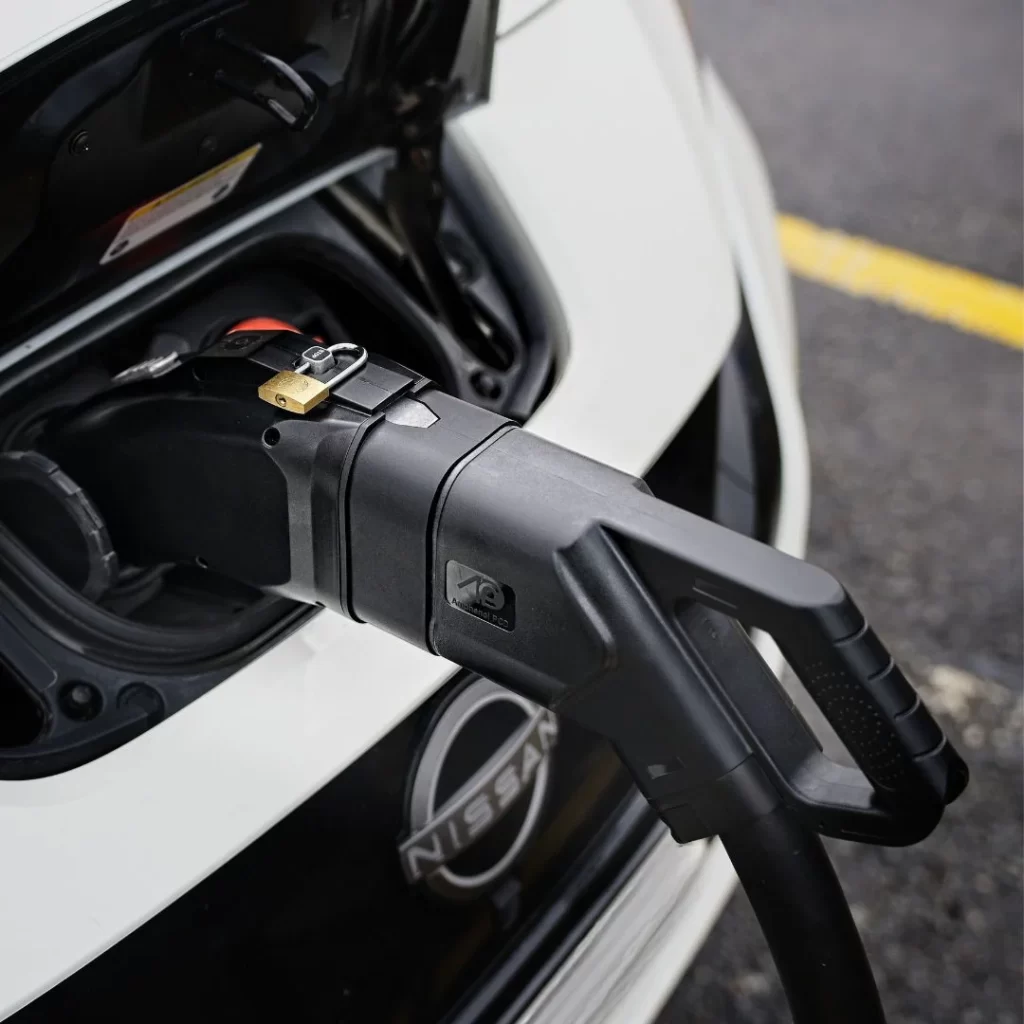
In many cases, yes. If your Leaf has a CHAdeMO fast-charging port and you use a CCS2 to CHAdeMO adapter designed for the European CCS2 connector, you can often charge at CCS fast chargers that would otherwise be unusable. The key word is often, because real-world compatibility depends on the charger hardware, your car, and the adapter’s firmware.
Which older Nissan Leaf models does this apply to?
When people say “older Leaf”, they usually mean the first-generation cars with 24 kWh or 30 kWh batteries. The same adapter idea can also matter for the second-generation Leaf (40 kWh) and Leaf e+ (62 kWh), because they still rely on CHAdeMO for DC fast charging.
In every case, the deciding factor is simple: does your car have the CHAdeMO fast-charging inlet?
Is your Leaf compatible with a CCS adapter?
The adapter only helps if your Leaf can already do DC fast charging via CHAdeMO. Some early Leafs and some trim levels in certain markets were sold without the CHAdeMO port.
A quick visual check is enough. Open the charging flap:
- If you see two ports (a smaller AC port plus a larger round CHAdeMO port), you’re in business.
- If you only see the AC port, a CCS adapter will not solve it.
It’s also worth keeping expectations realistic. The adapter does not turn your Leaf into a CCS car. It simply lets your Leaf talk to certain CCS stations.
How does a CCS2 to CHAdeMO adapter actually work?
CHAdeMO and CCS are both DC fast-charging systems, but they use different connector hardware and different communication methods. That’s why a CCS2 to CHAdeMO adapter is not a passive “shape changer.” It’s an active device that translates the safety handshake between the charger and the car.
For a long time, a practical CCS2-to-CHAdeMO adapter was considered a hard problem. In December 2023, Dongguan Longood Technology was the first to bring a CCS2 to CHAdeMO adapter to market that was widely seen as genuinely usable in real-world charging.
Because the adapter is doing protocol translation in the background, results can still depend on the exact station hardware, site configuration, and firmware versions. If that translation is slightly off for a specific charger brand or a particular site, the session may fail to start or stop unexpectedly.
What charging speed can an older Leaf expect on a CCS charger?
This is where many owners get disappointed, so it’s worth being direct.
Your Leaf still decides the charging power. The station can be rated at 150 kW or 300 kW, but an older Leaf will typically charge in the tens of kilowatts and taper as the battery fills.
In practice, charging speed depends more on these factors than on whether you use native CHAdeMO or CCS through an adapter:
- State of charge: charging slows down noticeably as you approach a high percentage.
- Battery temperature: very cold or very warm packs charge more slowly.
- Repeated fast charges: on longer days, charging can slow if the battery heat builds up.
- Station behaviour: some stalls are simply better than others.
The adapter usually does not make your Leaf charge faster in an absolute sense. The benefit is that it can help you find a better station. If your only nearby CHAdeMO option is an older, underperforming unit, having access to modern CCS hardware can help you reach your Leaf’s normal best-case speeds more often.
Will it work on every CCS charger?
No adapter solution can honestly promise 100 percent coverage across every charger brand, software version, and site setup.
What you can expect from a good CCS2 to CHAdeMO adapter is broad compatibility that improves over time as firmware updates add fixes for edge cases. Still, it’s smart to plan like a seasoned EV driver:
- Treat your first few sessions as testing runs close to home.
- Keep a backup option in mind on long trips.
- Be ready to move to another stall if one unit refuses to start.
Also note that access rules can vary by operator. For example, some networks may restrict certain third-party accessories or require very specific session flows in their app. If a location is critical to your trip, it is worth checking the operator’s current guidance before you rely on it.
Is a CCS adapter worth it for an older Leaf?
For many owners, the value is simple: more options.
A CCS2 to CHAdeMO adapter can make longer trips more relaxed, reduce detours to find the one working CHAdeMO plug, and give you alternatives when the only CHAdeMO connector at a site is busy.
It also helps future-proof the car. As networks keep prioritising CCS for new fast-charging sites, having CCS access can make an older Leaf feel much less “limited” in daily use and on longer journeys.
If you mostly charge at home and only use public DC charging occasionally, you may not need one. But if you road-trip, drive across regions where CHAdeMO coverage is thin, or want to keep your Leaf convenient as networks continue prioritising CCS, an adapter can be one of the most meaningful upgrades you can buy for an older Leaf.
That usability can matter for resale value too. When a buyer knows the car can realistically use modern CCS stations with an adapter, the Leaf is easier to sell and easier to justify compared to a CHAdeMO-only car.
What should you look for when choosing a CCS adapter for your Nissan Leaf?
Start with the basics: in Europe you need a CCS2 to CHAdeMO adapter. If a listing is vague about CCS1 vs CCS2, or the product photos don’t clearly match CCS2, move on.
Next, prioritise support and updates. These adapters are active translators, and compatibility can depend on firmware. A good seller should be able to explain how updates work, where you get the files later, and what to do if a session fails at a specific charger brand or site.
Safety and build quality are where the cheap options can cost you time and stress. Look for a clearly identified manufacturer or EU seller, sensible instructions, and a return/warranty policy that you can actually use. Practical details matter too: solid connector fit without wobble, a reliable locking mechanism, and weather sealing that matches outdoor use.
Finally, keep expectations realistic about speed. Your Leaf will still charge like a Leaf, so the value is not unlocking 150–300 kW charging. The value is access to more locations and the ability to choose better sites, which can help you hit your car’s normal best-case charging more consistently.
What’s a next step?
If you decide an adapter makes sense, focus on a unit that is designed specifically for CCS2 to CHAdeMO use in Europe, with clear instructions, support, and a realistic firmware update path.
At Autonlaturit.com we offer the Longood CCS2 to CHAdeMO adapter for Leaf owners who want access to modern CCS fast chargers. If you’re unsure whether your specific model year or charging habits make an adapter worthwhile, our support team can help you sanity-check the decision before you buy.